
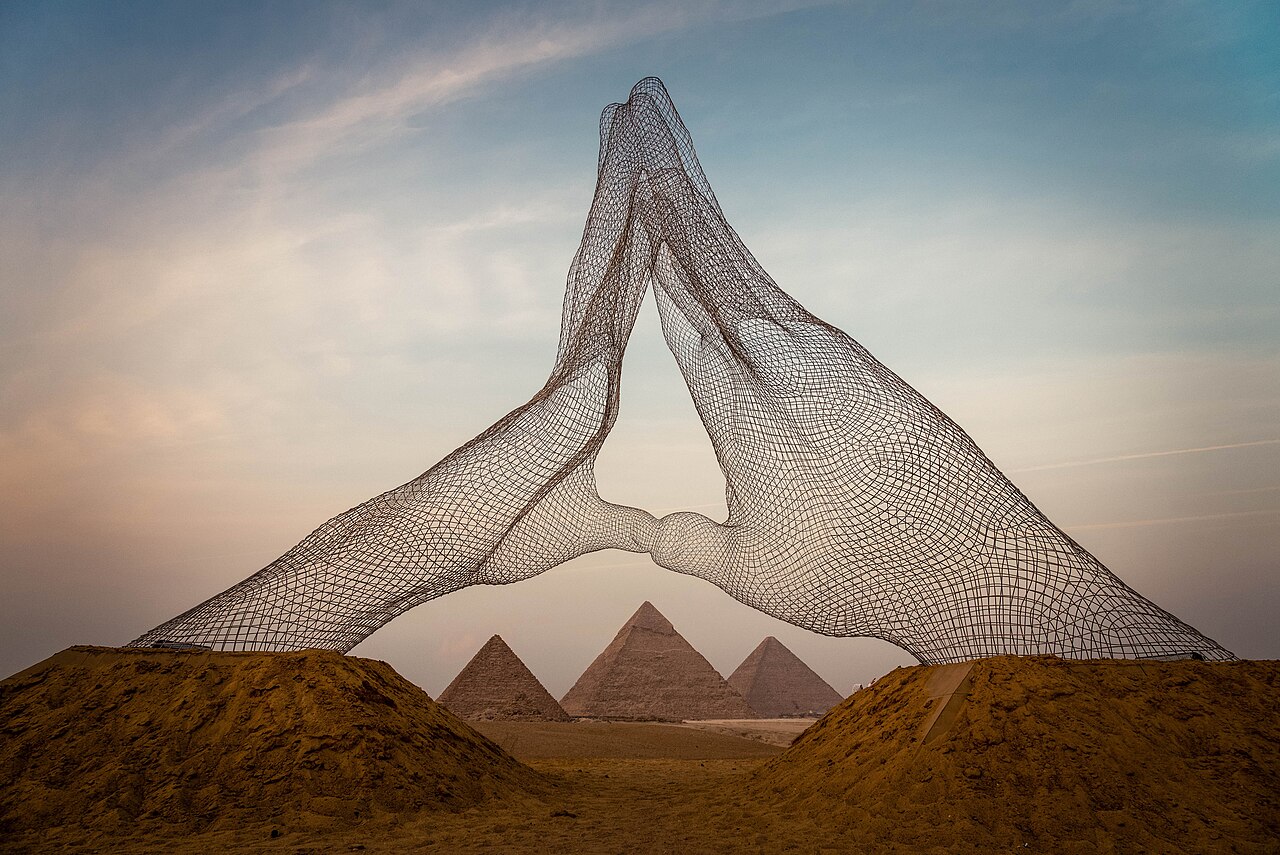
Ancient Egypt left behind monuments that have stood for more than four thousand years, and others we now know only from texts. Here is a journey up the Nile, from Giza to Nubia, with the locations, dates and the essentials to remember about each.
The Giza Plateau
On the edge of Cairo, the Giza plateau gathers the most famous monuments of antiquity. Three royal pyramids of the Fourth Dynasty rise here in masses of limestone, watched over by a colossal sphinx.
-
Pyramid of Khufu — Giza — c. 2560 BC — The largest of the three, originally about 146 metres tall. It remained the tallest structure built by humans for nearly four thousand years, and is the only one of the seven wonders of the ancient world still standing.
-
Pyramid of Khafre — Giza — c. 2530 BC — Slightly smaller than his father’s, it sometimes looks taller because it sits on higher ground. It still keeps part of its original casing of polished limestone near the summit.
-
Pyramid of Menkaure — Giza — c. 2500 BC — The most modest of the trio, but linked to remarkable statues of the king found in its temple. Its base was partly faced with pink granite from Aswan.
-
Great Sphinx — Giza — c. 2500 BC — A monumental statue with a lion’s body and a human head, carved from an outcrop of the plateau. About 73 metres long, it has guarded the pyramids since the Fourth Dynasty.
Luxor and Thebes
Further south, on both banks of the Nile, lay Thebes, Egypt’s religious capital during the New Kingdom. The east bank held the temples of the living; the west bank, the tombs of the kings.
-
Temple of Karnak — Thebes (Luxor) — expanded from the 16th to the 1st century BC — The vastest religious complex in Egypt, dedicated chiefly to the god Amun. Its hypostyle hall lines up 134 giant columns, some over twenty metres high.
-
Temple of Luxor — Luxor — built from the 14th century BC — Once joined to Karnak by a long avenue of sphinxes, it rose largely under Amenhotep III and Ramesses II. Its obelisks and colossi mark the monumental entrance.
-
Valley of the Kings — west bank, facing Luxor — 16th to 11th century BC — A necropolis cut into the rock where the pharaohs of the New Kingdom were buried, its walls covered with funerary texts and painted scenes.
-
Tomb of Tutankhamun — Valley of the Kings — c. 1323 BC — The burial of a king who died young, left almost intact until Howard Carter found it in 1922. The treasure it held, including the golden mask, gave the site its worldwide fame.
Nubia
Travelling further upriver to the south, near the Sudanese border, Ramesses II had the most spectacular temples of his reign cut into the cliff. Their rescue in the 20th century is still remembered.
-
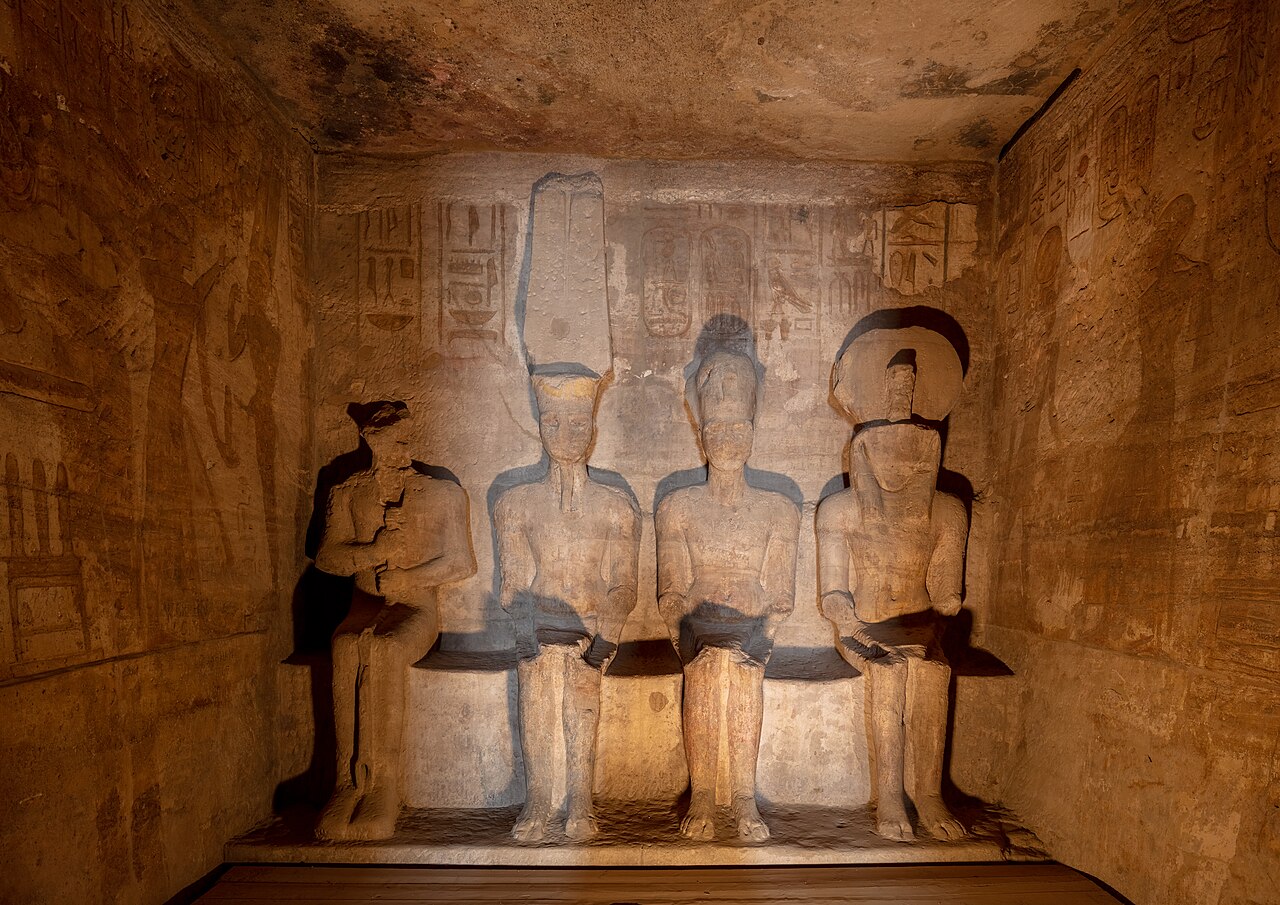
Great Temple of Abu Simbel — Nubia, southern Egypt — c. 1264 BC — A sanctuary hewn into the sandstone by Ramesses II, its façade bearing four seated colossi over twenty metres tall. Twice a year the sun reaches the inner shrine and lights up the statues within.
-
Small Temple of Abu Simbel — Nubia — c. 1264 BC — Dedicated to the goddess Hathor and to Queen Nefertari, wife of Ramesses II, in a rare case where the queen appears on the façade at the same scale as the king.
In the 1960s, both temples were about to vanish beneath the waters of Lake Nasser, formed by the Aswan High Dam. An international campaign led by UNESCO cut them into more than a thousand blocks, then reassembled them some sixty metres above their original site. It remains one of the great heritage rescues of the century.
Other Treasures
Egypt is not only its pyramids and great temples. Some of its monuments have been moved, others have vanished, but their memory matters just as much.
-
Temple of Philae — an island near Aswan — Ptolemaic and Roman period, 3rd century BC to 1st century AD — A sanctuary dedicated to the goddess Isis. Also threatened by rising water, it was dismantled and rebuilt on the neighbouring island of Agilkia, another UNESCO undertaking.
-
Lighthouse of Alexandria — Alexandria — 3rd century BC — One of the seven wonders of the ancient world, probably around a hundred metres tall. Destroyed by earthquakes between the 14th and 15th centuries, it survives only as blocks reused in the Qaitbay Citadel and ruins under the sea.
-
Library of Alexandria — Alexandria — founded in the 3rd century BC — The most famous centre of learning in antiquity, meant to gather every text in the known world. Destroyed gradually over the centuries, it left no physical trace, yet remains a symbol of lost knowledge.
To fix all these names and dates in mind without burning out, the SAPIRO app offers quizzes that turn them into instinct. To widen the picture, read our feature on the wonders of the world, our tour of ancient monuments, and our pick of 30 famous monuments. It is all filed under our monuments section.
Frequently Asked Questions
What is the largest pyramid in Egypt?
The Great Pyramid of Khufu at Giza, completed around 2560 BC. It originally stood about 146 metres tall and remains the tallest of the plateau’s three pyramids. It is also the only one of the seven wonders of the ancient world still standing today.
Why were the temples of Abu Simbel moved?
In the 1960s, the building of the Aswan High Dam threatened to drown both temples under the waters of Lake Nasser. Under the banner of UNESCO, they were cut into more than a thousand blocks and reassembled some sixty metres higher up, exactly as before.
Where is the tomb of Tutankhamun?
In the Valley of the Kings, on the west bank of the Nile facing Luxor (ancient Thebes). Found almost intact by Howard Carter in 1922, it held thousands of objects, including the famous golden funerary mask, now one of the best-known works of Egyptian art.
Does the Lighthouse of Alexandria still exist?
No. The Lighthouse of Alexandria, one of the seven wonders of the ancient world, was destroyed by a series of earthquakes between the 14th and 15th centuries. Some of its blocks were reused in the Qaitbay Citadel, built on its site, and remains lie on the harbour floor.