
Antiquity left behind monuments that still stand after two or three thousand years, and others we now know only from their ruins. Here is a tour of the most striking ones, grouped by civilisation, with their dates and the essentials to remember.
Ancient Egypt
The Nile valley produced the oldest massive monuments still visible today. Stone replaced perishable materials early on, which explains their longevity.
-
Pyramids of Giza — Giza, Egypt — c. 2560 BC — Three royal pyramids of the Fourth Dynasty, including Khufu’s, long the tallest structure ever built by humans. They housed the tombs of the pharaohs.
-
Great Sphinx — Giza, Egypt — c. 2500 BC — A monumental statue with a lion’s body and a human head, carved from a limestone outcrop. It guards the plateau next to the pyramids.
-
Temples of Karnak and Luxor — Thebes (Luxor), Egypt — built and expanded from the 16th to the 1st century BC — Vast complexes dedicated to the god Amun, once linked by an avenue of sphinxes. The hypostyle hall at Karnak lines up 134 giant columns.
-
Abu Simbel — southern Egypt — c. 1264 BC — Two temples cut into the cliff by Ramesses II, with four colossi over twenty metres tall on the façade. The whole site was dismantled and rebuilt higher up in the 1960s to escape the rising waters of Lake Nasser.
Ancient Greece
Classical Greece bet less on sheer mass than on proportion. Its monuments served worship, politics, or performance, and their influence on Western architecture has been lasting.
-
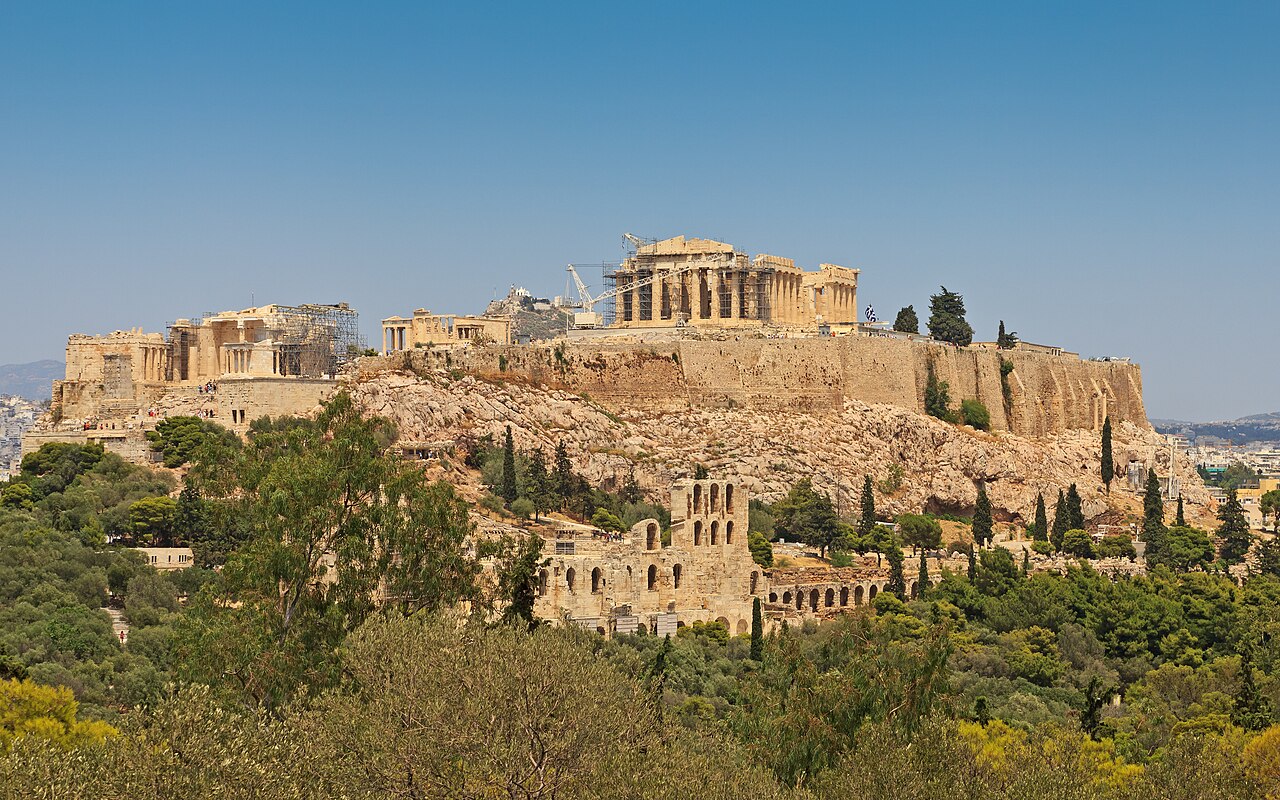
Parthenon and Acropolis — Athens, Greece — 447-432 BC — A Doric temple dedicated to Athena, raised on the sacred hill of the Acropolis. Damaged by an explosion in 1687, it remains the symbol of Greek architecture.
-
Sanctuary of Delphi — Delphi, Greece — peak in the 6th-4th centuries BC — Home of the oracle of Apollo, which the Greeks regarded as the centre of the world. The Pythia was consulted there before major decisions.
-
Theatre of Epidaurus — Epidaurus, Greece — c. 340-330 BC — An open-air theatre famous for its acoustics: a coin dropped on the stage can be heard from the top rows. It could hold close to 14,000 spectators.
Ancient Rome
Rome industrialised construction. The arch, the vault, and above all concrete made possible structures of unprecedented scale, civic as much as religious.
-
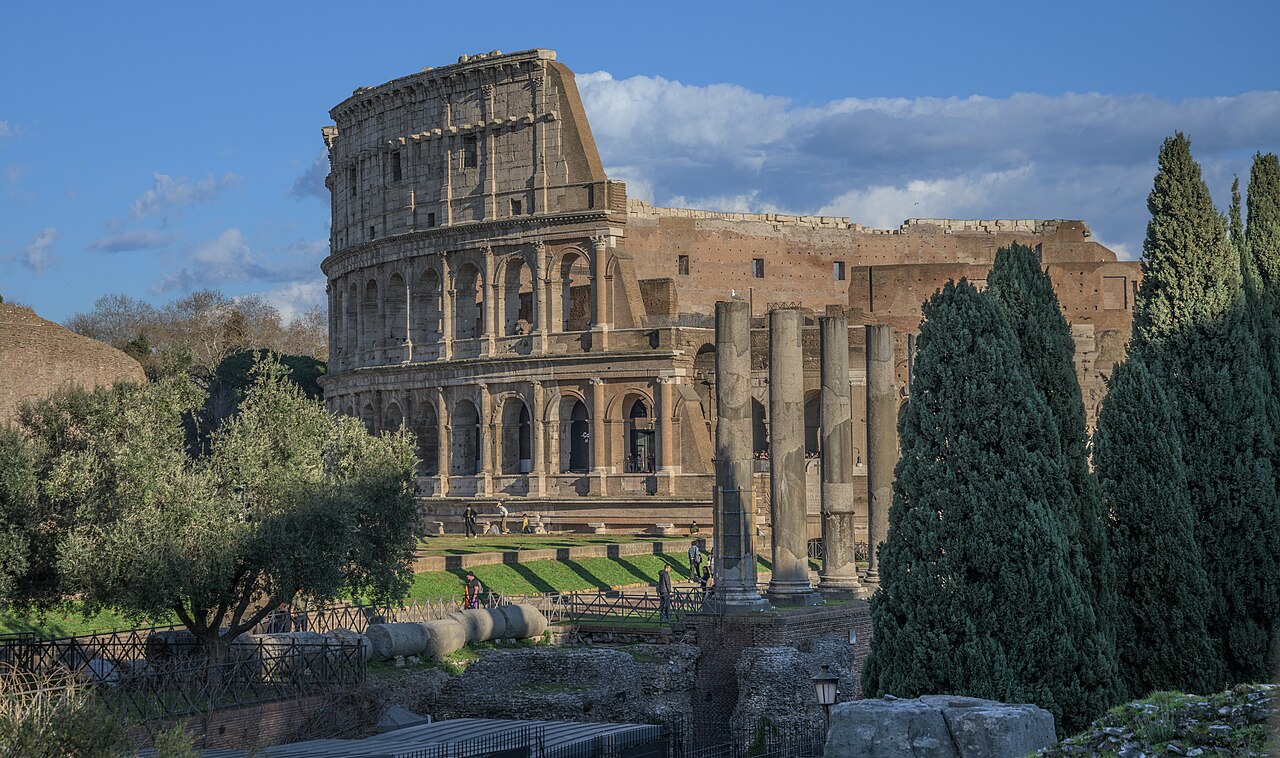
Colosseum — Rome, Italy — AD 80 — The Flavian Amphitheatre, the largest in the Empire, able to gather around 50,000 spectators for gladiatorial combat and animal hunts.
-
Pantheon — Rome, Italy — rebuilt c. AD 125 — A temple to all the gods crowned by a concrete dome pierced with an oculus. Its dome, 43 metres across, is still the largest in the world without metal reinforcement.
-
Roman Forum — Rome, Italy — from the 7th century BC into the imperial era — The political, religious, and commercial heart of the city, lined with temples, basilicas, and triumphal arches now in ruins.
-
Pont du Gard and aqueducts — near Nîmes, France — 1st century AD — A three-tiered arched aqueduct that crossed the Gardon valley to supply Nîmes with water. A monument to Roman hydraulic engineering.
-
Pompeii — near Naples, Italy — frozen in AD 79 — A town buried by the eruption of Vesuvius, whose ash preserved streets, houses, and frescoes. A unique snapshot of everyday Roman life.
Beyond the Greco-Roman World
Antiquity does not stop at the Mediterranean. Other civilisations built monuments just as remarkable, sometimes on the far side of the globe.
-
Petra — southern Jordan — peak from the 1st century BC to the 1st century AD — Capital of the Nabataeans, whose façades, like the Khazneh, are carved into the rose-coloured rock. The city thrived on caravan trade.
-
Persepolis — southern Iran — founded c. 518 BC — The ceremonial capital of the Achaemenid Persian Empire, commissioned by Darius I. Its terraces and relief-carved staircases were burned by Alexander the Great in 330 BC.
-
Ziggurat of Ur — Mesopotamia (modern Iraq) — c. 2100 BC — A stepped temple of mud brick dedicated to the moon god Nanna. Its restored base gives a sense of these tiered pyramids typical of the region.
-
Great Wall of China — northern China — first sections joined around 220 BC — A system of fortifications whose unification began under the first emperor, Qin Shi Huang. Most of what is visible today, however, dates from the much later Ming period.
-
Mayan temples — Mesoamerica (Mexico, Guatemala) — Classic period, 3rd-9th century AD — Stepped pyramids topped by shrines, as at Tikal or Palenque, at the heart of rival city-states. They served both worship and astronomical observation.
To fix all these landmarks in mind without burning out, the SAPIRO app offers quizzes that turn these names and dates into instinct. To widen the picture, read our feature on the wonders of the world, our pick of 30 famous monuments, and our guide to UNESCO World Heritage Sites. To place these monuments on a timeline, see our overview of Antiquity, Middle Ages and Renaissance. And for entire cities pulled back from oblivion, see the lost cities that were found again. It is all filed under our monuments section.
Frequently Asked Questions
What is the oldest ancient monument still standing?
The pyramids of Giza top the list. The Great Pyramid of Khufu, completed around 2560 BC, is more than four and a half thousand years old and the only one of the seven ancient wonders still visible. Older structures existed in Mesopotamia, but only ruins or foundations survive.
Is the Colosseum really from antiquity?
Yes. The Flavian Amphitheatre, to give it its proper name, was inaugurated in AD 80 under the emperor Titus, at the height of the Roman imperial period. It belongs firmly to antiquity, unlike many monuments often mistaken for it that are in fact medieval.
Why is so little left of ancient Greek monuments?
Several factors combine: earthquakes, reuse of the stone in later buildings, looting, and explosions such as the one that wrecked the Parthenon in 1687. Marble was also easy to burn into lime. What survives, like the Acropolis of Athens, often owes its condition to modern restoration.
Are Petra and Persepolis part of the Greco-Roman world?
No, and that is the point. Petra was the capital of the Nabataeans, an Arab people, and Persepolis that of the Achaemenid Persian Empire. Both cities are a reminder that antiquity reaches well beyond Greece and Rome, even if their paths sometimes crossed.