
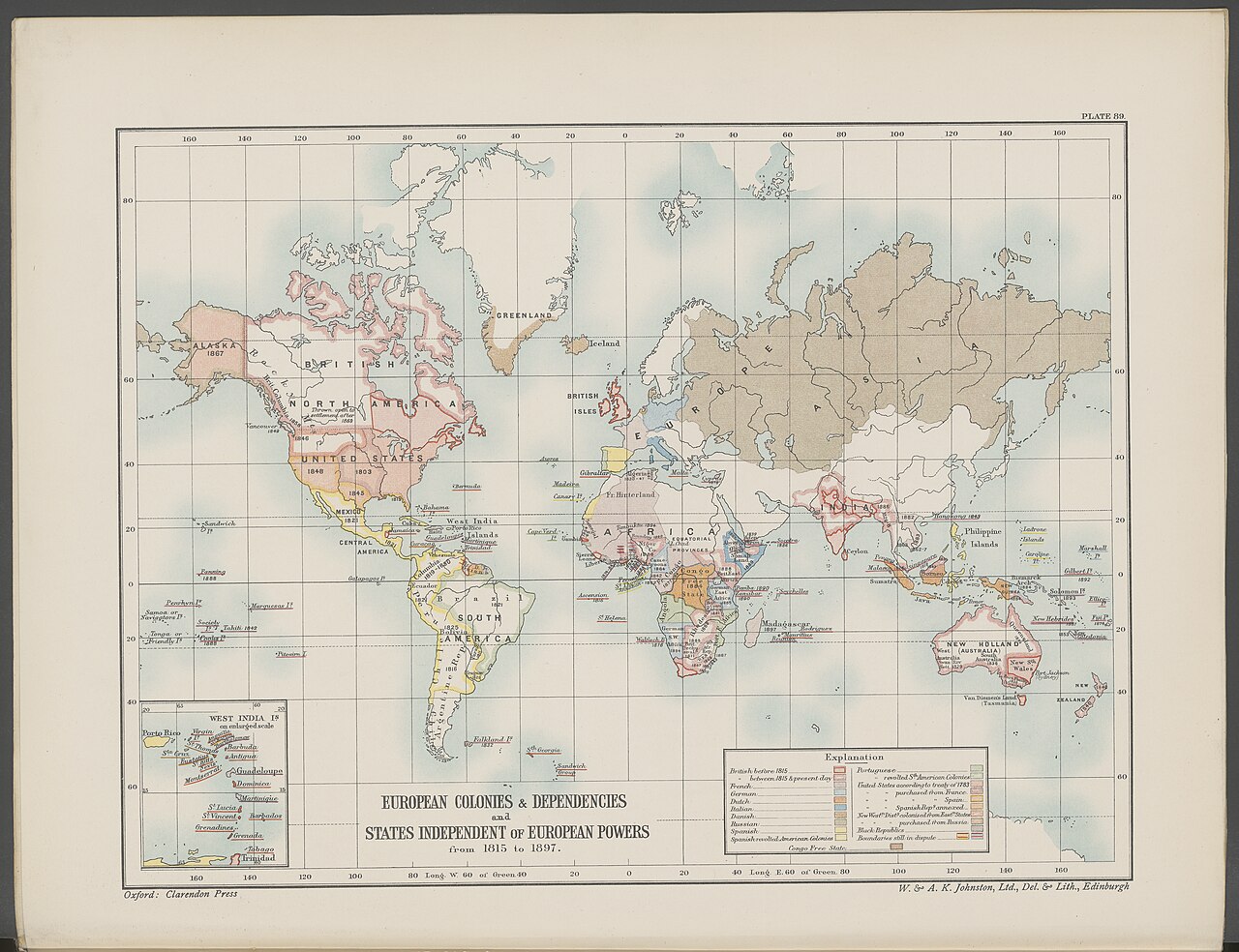
The largest empire in history is the British Empire, with about 35.5 million km² at its peak around 1920, nearly a quarter of the world’s land area. Next come the Mongols, then the Russians, before the gaps start to narrow. Empire sizes from earlier eras are estimates, but historians broadly agree on the orders of magnitude. The ranking below covers the top ten, by maximum land area.
1. British Empire (~35.5 M km², around 1920)
At its peak after the First World War, the British Empire covered about 35.5 million km² and held close to a quarter of the world’s land and population. It was known as “the empire on which the sun never sets,” since its territories spanned every time zone.
2. Mongol Empire (~24 M km², 13th century)
Founded by Genghis Khan, the Mongol Empire reached about 24 million km² in the 13th century. It is the largest contiguous empire in history: its territory ran without interruption from Korea to Hungary.
3. Russian Empire (~22.8 M km², around 1895)
The Russian Empire covered about 22.8 million km² around 1895, from Poland to the Pacific. It even included Alaska, sold to the United States in 1867.
4. Qing Dynasty (~14.7 M km², 18th century)
China’s last imperial dynasty reached about 14.7 million km² in the 18th century. Its borders largely match those of modern China.
5. Spanish Empire (~13.7 M km², 18th century)
The Spanish Empire covered about 13.7 million km² in the 18th century, from the Americas to the Philippines. It is considered the first global empire, present in both hemispheres.
6. Second French Colonial Empire (~11.5 M km², around 1920)
The second French colonial empire reached about 11.5 million km² around 1920. Its holdings were concentrated mainly in Africa and Indochina.
7. Abbasid Caliphate (~11.1 M km², 8th-9th century)
The Abbasid Caliphate covered about 11.1 million km² between the 8th and 9th centuries, with Baghdad as its capital. It is associated with a scientific and intellectual golden age of the Muslim world.
8. Umayyad Caliphate (~11.1 M km², 8th century)
Barely a century after its founding, the Umayyad Caliphate already stretched from Spain to the Indus, covering about 11.1 million km² in the 8th century. Few empires have grown so fast.
9. Yuan Dynasty (~11 M km², 13th-14th century)
The Yuan Dynasty, founded by Kublai Khan, grandson of Genghis Khan, covered about 11 million km² between the 13th and 14th centuries. It was China under Mongol rule.
10. Portuguese Empire (~10.4 M km² at its peak)
The Portuguese Empire reached about 10.4 million km² at its peak, Brazil included. It is the longest-lasting of the colonial empires: from the capture of Ceuta in 1415 to the handover of Macau in 1999.
The largest empires at a glance
| Rank | Empire | Max area (M km²) | Peak |
|---|---|---|---|
| 1 | British Empire | ~35.5 | around 1920 |
| 2 | Mongol Empire | ~24 | 13th century |
| 3 | Russian Empire | ~22.8 | around 1895 |
| 4 | Qing Dynasty | ~14.7 | 18th century |
| 5 | Spanish Empire | ~13.7 | 18th century |
| 6 | French Colonial Empire | ~11.5 | around 1920 |
| 7 | Abbasid Caliphate | ~11.1 | 8th-9th century |
| 8 | Umayyad Caliphate | ~11.1 | 8th century |
| 9 | Yuan Dynasty | ~11 | 13th-14th century |
| 10 | Portuguese Empire | ~10.4 | 16th-18th century |
Several of these empires eventually became countries that no longer exist. Much of their story played out in the great battles of history, which are easier to place on the world history timeline.
Frequently asked questions
What is the largest empire in history?
The British Empire is the largest empire in history, with about 35.5 million km² at its peak around 1920. It then held close to a quarter of the world’s land area and population.
What is the largest contiguous empire?
The Mongol Empire is the largest contiguous empire, with about 24 million km² in the 13th century. Unlike the British Empire, scattered across the oceans, its territory stretched without interruption from Korea to Hungary.
Which empire lasted the longest?
The Roman Empire, if its Byzantine continuation is included, lasted about 1,500 years, from the end of the Roman Republic to the fall of Constantinople in 1453. Among colonial empires, the Portuguese was the most enduring, spanning nearly six centuries from Ceuta (1415) to Macau (1999).
Where does the Roman Empire rank on this list?
The Roman Empire does not make the top 10 by area: it covered about 5 million km² at its peak under Trajan, in the 2nd century. Its influence on law, languages and institutions nevertheless remains among the deepest in history.