
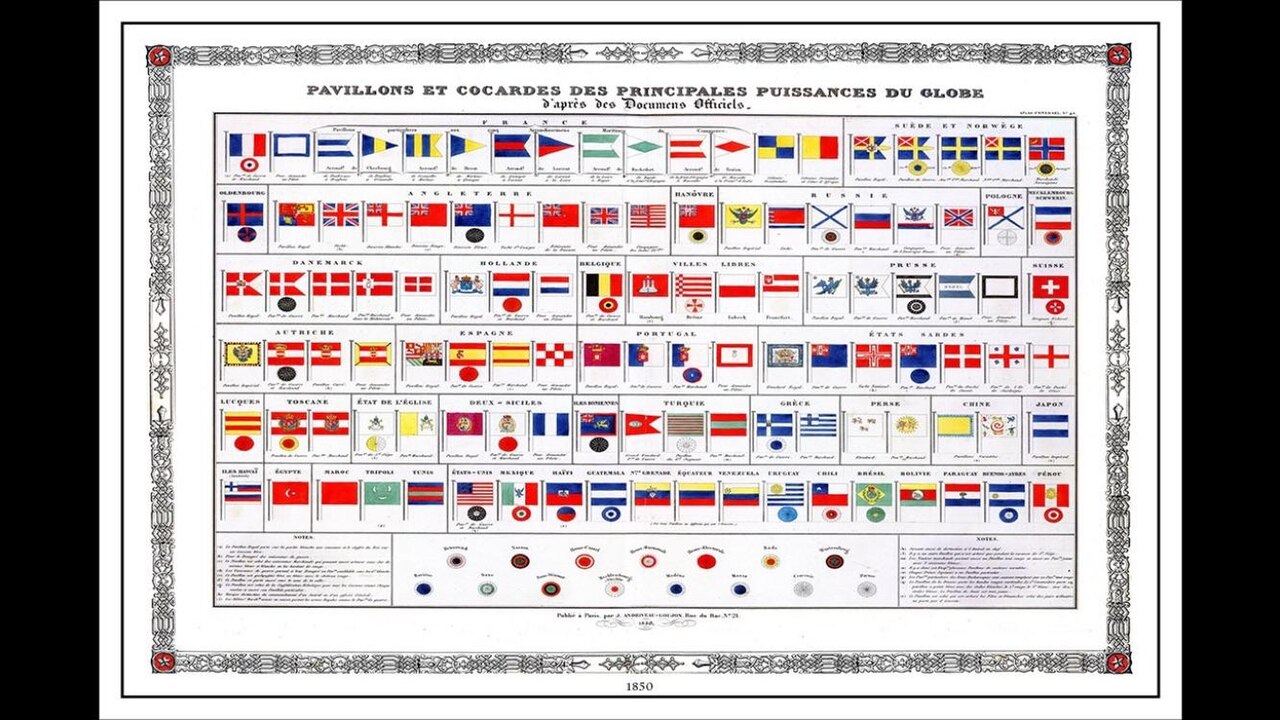
Some of history’s most recognisable flags belong to countries that no longer exist. When a state collapses, splits or is absorbed, its banner usually vanishes with it, but often stays famous for decades. Here are 10 flags of countries that have disappeared, and the story of each.
1. Soviet Union (1922–1991)
A red field with a gold hammer and sickle and a five-pointed star. It symbolised the union of workers and peasants under communism. It disappeared in December 1991 when the USSR broke apart into fifteen independent republics.
2. Yugoslavia (1918–1992)
A blue-white-red horizontal tricolour, later with a red star in the centre for the socialist federation. The flag disappeared as the country fractured through the wars of the 1990s into Slovenia, Croatia, Bosnia, Serbia, Montenegro, North Macedonia and Kosovo.
3. East Germany (1949–1990)
The black-red-gold tricolour of Germany, but charged with the socialist state emblem: a hammer and compass within a ring of rye. It vanished with German reunification in October 1990.
4. Czechoslovakia (1918–1992)
A white-and-red horizontal design with a blue triangle at the hoist. When the country peacefully split in 1993, the Czech Republic kept the flag and Slovakia adopted a new one.
5. South Vietnam (1955–1975)
A yellow field with three horizontal red stripes. It disappeared when Saigon fell in 1975 and the country was reunified under the North. The banner is still flown by many Vietnamese communities abroad.
6. Rhodesia (1965–1979)
A green-white-green flag bearing the country’s coat of arms. Rhodesia’s white-minority government ended in 1979, and the country became Zimbabwe with a new flag in 1980.
7. Ottoman Empire (until 1922)
A red field with a white crescent and star, the direct ancestor of the modern Turkish flag. The empire was abolished in 1922 and replaced by the Republic of Turkey.
8. Austria-Hungary (until 1918)
The dual monarchy used combined imperial and royal arms rather than a single simple flag. It dissolved at the end of the First World War into Austria, Hungary, Czechoslovakia and parts of Yugoslavia.
9. Republic of Texas (1836–1845)
The famous “Lone Star” flag: a blue vertical band with a single white star, beside white and red horizontal bars. Texas joined the United States in 1845, but kept the flag, which is now its state banner.
10. Tibet (used until 1951)
The “snow lion” flag, with two lions, a sun and mountains. It was the banner of the Tibetan government until 1951 and is still used today by Tibetans in exile, though it is banned within Tibet.
Vanished flags at a glance
| Flag | State | Disappeared |
|---|---|---|
| Hammer and sickle | Soviet Union | 1991 |
| Tricolour with red star | Yugoslavia | 1992 |
| Hammer and compass | East Germany | 1990 |
| Blue triangle | Czechoslovakia | 1992 |
| Yellow with red stripes | South Vietnam | 1975 |
| Green with arms | Rhodesia | 1979 |
| Crescent and star | Ottoman Empire | 1922 |
| Imperial arms | Austria-Hungary | 1918 |
| Lone Star | Republic of Texas | 1845 |
| Snow lion | Tibet | 1951 |
To go further, read about the countries that no longer exist and the meaning of flags.
Frequently asked questions
What happens to a country’s flag when it disappears?
When a state ceases to exist, its flag is usually retired. Sometimes a successor keeps it (the Czech Republic kept the Czechoslovak flag), and sometimes it lives on with communities in exile, as with South Vietnam or Tibet.
What was the flag of the Soviet Union?
The flag of the Soviet Union was a plain red field with a gold hammer and sickle crossed beneath a five-pointed star, in the upper hoist. It was used from 1922 until the USSR dissolved in 1991.
Which disappeared flag is still used today?
Several are still flown. The Lone Star of the Republic of Texas became the US state flag, the Tibetan snow-lion flag is used by exiles, and the South Vietnamese flag remains a symbol for the Vietnamese diaspora.
Why did the Yugoslav flag disappear?
The Yugoslav flag disappeared because the country itself broke apart during the wars of the 1990s. Each successor state (Slovenia, Croatia, Bosnia, Serbia, Montenegro, North Macedonia and Kosovo) adopted its own flag.